
If your home’s sunny side is covered in stink bugs this week, you’re not infested — you’re a landmark. Every fall in Holly Springs, stink bugs, Asian lady beetles, and boxelder bugs gather on warm south- and west-facing walls by the hundreds, soaking up heat. Then, as the nights cool, they follow the warmth into the wall voids, attic, and window frames — and spend the winter inside your house, emerging on mild days from October through March.
They don’t bite, they don’t eat your food, and they don’t breed indoors. They’re overwintering: using your walls the way they’d use a hollow tree. The problem isn’t danger — it’s that once they’re in the voids, they trickle into living spaces all winter long, and there’s no clean way to treat them there. Fall is won or lost outside, in October.
Meet the three usual suspects
- Brown marmorated stink bugs — shield-shaped, mottled brown, about 3/4 inch. The ones crowding your siding and window screens. Famous for the defensive spray they release when crushed or vacuumed in bulk.
- Asian lady beetles — look like ladybugs but range from pale orange to red, often with an “M” marking behind the head. They cluster in upper corners and around windows, can stain surfaces with a yellowish fluid, and give off a musty smell when they gather in numbers.
- Boxelder bugs — black with red-orange lines, about 1/2 inch, tied to boxelder and maple trees. They mass on sunny walls near their host trees and slip in through the same gaps.
All three share one behavior: they orient to warmth and light-colored, sun-exposed surfaces. Tall, pale, two-story homes near woods and fields — half of Holly Springs, Apex, and Fuquay-Varina — get the biggest gatherings.
What not to do
Don’t crush stink bugs indoors. The smell is the point — it’s a chemical defense, and it can draw more of them. Scoop them into soapy water instead.
Don’t seal them in. Caulking an entry point from the inside while bugs are already in the void traps them in the wall, where they die out of reach and become food for other pests. Exclusion happens on the exterior, before they move in — or after they’re out in spring.
Don’t spray the wall void. Insecticide inside a void mostly kills bugs where you can’t remove them. The fix is keeping them out in the first place.
Do vacuum carefully. A vacuum with a disposable bag (or a stocking over the hose) handles the ones that make it inside. Empty it outside, immediately — a vacuum full of stink bugs is a smell you’ll remember.
The October window
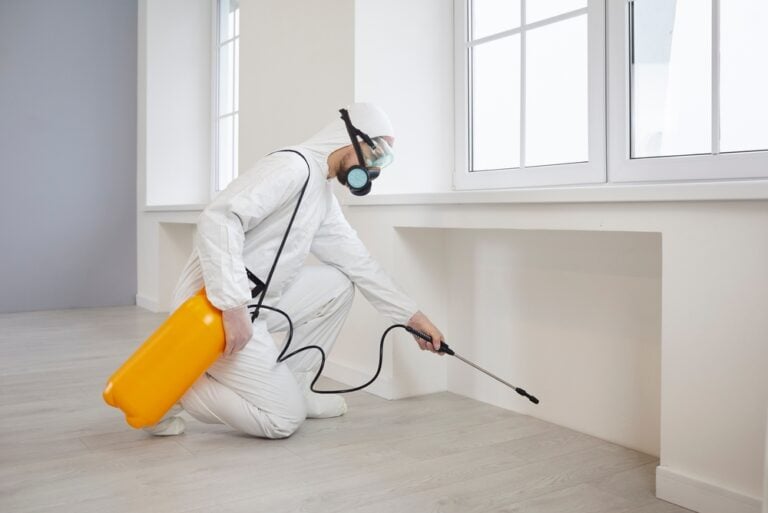
The treatment that works is an exterior barrier applied while the bugs are gathering but before they’ve moved deep into the structure — in our area, that’s roughly now through early November. We treat the sunny elevations, window and door frames, soffit lines, and the foundation entry points, and we seal the gaps they’re using: siding joints, utility penetrations, and attic vents with torn screens.
Once they’re inside the voids for the winter, the honest answer is that control gets limited — you’re managing emergences until spring. That’s why the fall exterior visit matters more for these pests than any other single service on the calendar, and why our quarterly customers in Garner and Cary rarely see them: the barrier is already up when the swarm arrives.
The bottom line
Overwintering pests are a timing problem, not a cleanliness problem. A spotless house with a sunny west wall and unsealed soffits will collect them every single year. Seal the entries, treat the exterior in October, and the winter trickle never starts.
Quarterly plans start at $49/month with no contract, backed by our No-Hassle Callback Guarantee — and new customers get $60 off the first service plus a free inspection. If your walls are already gathering a crowd, call (919) 446-3326 and we’ll get the barrier up before they move in.